The 2026 Cradle Is Not a Day
By Daniel Burkett ·
If you spend any time in astrology's corner of the internet, you've met the July 2026 cradle by now. The pitch is always some version of the same three claims: four planets line up at exactly four degrees of their signs, the pattern has never happened before in recorded history, and it all peaks on a single day — July 20 or 21, 2026. Screenshots of a chart wheel, a paragraph about breakthrough and transformation, a call to "watch the skies."
I want to do something the viral posts don't: run the numbers, all of them, and follow the geometry where it actually leads. Because the configuration is real — genuinely, verifiably real, which is more than most viral astrology can say — but the framing gets the physics exactly backwards. This is not a one-day event. It is a four-year field, and July 2026 is the single loudest beat in it.
This is the first of what I intend to be a running series of technical breakdowns. The house style is simple: every claim is computed, cross-checked, and reproducible. No screenshots standing in for evidence.
What people are sharing
The pattern has a name, two of them actually. Louise and Bruno Huber of the Astrological Psychology school called it the Cradle; the French mundane astrologer André Barbault, who wrote about this very 2020s configuration in Planetary Cycles, called it the Basket. Geometrically it is four bodies strung together by an opposition and a chain of soft aspects — a half-hexagon, a hammock slung between two poles.
For July 2026 the four bodies and their six aspects are:
Jupiter in Leo opposite Pluto in Aquarius — the spine.
Three sextiles forming the chain: Jupiter–Uranus, Uranus–Neptune, Neptune–Pluto.
Two trines closing the basket: Jupiter–Neptune and Pluto–Uranus.
One opposition, three sextiles, two trines. The two inner planets of the chain each trine the far pole; the whole thing hangs together only because all four sit near the same degree of their respective signs. That degree, the posts insist, is four.
First question: is it even real?
Most viral astrology rounds hard. A planet at 2.7° becomes "exactly 3°," and "tight" means "within about eight degrees if you squint." So before going anywhere interpretive, I computed the geocentric apparent positions for the peak window. Here is the sky for 21 July 2026, 00:00 UT:
Body Position Motion
Jupiter Leo 4.53° Direct
Uranus Gemini 4.61° Direct
Neptune Aries 4.37° Retrograde
Pluto Aquarius 4.43° Retrograde
The degrees are not rounded up. They are actually there, all four within a fifth of a degree of 4°30′. I've rarely seen a piece of astrology-content hype hold up this cleanly to a real ephemeris.
The six aspects are equally tight. Their orbs at that instant:
Aspect Orb
Jupiter ☍ Pluto -0.09°
Jupiter ⚹ Uranus -0.08°
Uranus ⚹ Neptune +0.24°
Neptune ⚹ Pluto −0.06°
Jupiter △ Neptune +0.16°
Pluto △ Uranus +0.18°
The widest link in the entire figure is a quarter of a degree. The tightest whole-figure moment — the instant that minimizes the largest orb — lands around July 20, 2026, 08:00 UT, with every aspect inside 0.21°. So the "peak on the 20th–21st" claim is right, and it leans to the 20th.
The three fast contacts perfect within a single thirty-hour span:
Jupiter trine Neptune — July 20, 07:23 UT
Jupiter opposition Pluto — July 20, 14:44 UT
Jupiter sextile Uranus — July 21, 11:10 UT
Those times match the published professional ephemerides to the minute, which is the first hint of where this is going. Notice which planet is doing all three: Jupiter.
The correction nobody makes
Look again at the motion column. Neptune and Pluto are both retrograde. Not just Pluto — Neptune too, having stationed retrograde on July 7, 2026. Of the dozens of write-ups I read while researching this, exactly one mentioned the retrograde condition at all. Everyone else treated it as a chart of four planets in forward motion, which it is not.
Why does the discourse drop it? Two reasons, one careless and one defensible. The careless one: people are working from a chart-wheel screenshot, and the exact-degree spectacle is the story they want to tell — retrograde is a footnote that complicates the "seize this breakthrough today" message. The defensible one: in mundane work, many astrologers deliberately down weight transiting outer-planet retrograde. It's an artifact of Earth's faster orbit rather than a true reversal, and the outer planets are retrograde roughly forty percent of every year. It reads as ambient rather than event-like.
But dropping it costs you the single most important thing about this configuration — the thing that explains why it isn't a one-day event at all.
Trigger versus field
Here is the reframe. Run the exact perfection of each of the six aspects not just for July 2026 but across the whole outer-planet cycle, 2025 through 2029, and the six legs split into two completely different kinds of thing.
Jupiter's three legs each perfect exactly once. Jupiter is fast and direct. It sweeps into Leo in late June 2026, makes its opposition to Pluto and its trine to Neptune and its sextile to Uranus all within thirty hours, and then it leaves. None of those three contacts ever recurs in this cycle. Jupiter is the trigger — the fast body that happens to be passing through when the shutter clicks.
The three slow legs perfect over and over. Because Uranus, Neptune, and Pluto are all crawling — and looping backward across the same degrees on their retrograde stations — the aspects between them re-perfect again and again:
Slow leg Exact perfections Count
Uranus ⚹ Neptune 2025–2027 5×
Pluto △ Uranus 2026–2028 5×
Neptune ⚹ Pluto 2026–2029 7×
Seventeen exact perfections among the three slow planets, running out to May 2029 — and nearly every one of them occurs with at least one of the two bodies retrograde. That is the "multi-year field lasting into the late 2020s" that the popular posts assert but never actually locate. It isn't hand-waving. It's a specific list of retrograde-driven re-perfections, and the retrograde stations are the clock the whole thing runs on. Barbault, writing decades ago, expected exactly this — a sustained phase, not a flashbulb — and pinned it to the years 2026 through 2028.
So the honest picture is a standing three-legged field that holds for four years, with Jupiter dropping in for one week in July 2026 to complete it and make it briefly spectacular.
The empty apex, and everything that fills it
Once you see the standing field as the real object, a further question opens up. The three slow planets hold three of the four corners. The fourth corner — the apex in early Leo, opposite Pluto — is a socket. Jupiter filled it in July 2026. But the socket doesn't care which body fills it. Anything that transits the Leo apex opposite Pluto steps into Jupiter's vacated role and re-forms the entire cradle for as long as it's there.
So I computed every fast body's completion of the apex across the window — every moment the transiting body simultaneously opposes Pluto, trines Neptune, and sextiles Uranus — and measured how completely it manages it. The socket gets filled at wildly different tempos:
The Moon completes it 53 times — roughly once a month, every time it crosses the apex zone. A steady pulse under everything.
The Sun completes it once a year, in late July, four years running: July 24, 2025; July 27, 2026; July 30, 2027; August 2, 2028.
Mercury and Venus complete it each summer, clustered near the Sun.
Mars, which only reaches Leo every couple of years, fills the apex alone on October 5, 2026 — a malefic rocking the cradle three months after everyone stopped watching.
Jupiter, once — the headline — and then gone.
Two findings fall out of this that are worth sitting with.
The Sun re-rings the exact figure tighter than Jupiter did, six days later. Jupiter's famous peak was 0.21° at its widest. The Sun steps into the same socket on July 27, 2026 and completes the apex at 0.3°. Then it does it again every summer. The rare thing was never the geometry — it was Jupiter's slow presence. The geometry itself re-lights on an annual schedule.
The field has a built-in expiry, and you can read it in the drift. Watch the Sun's completion slide later each year — July 24, then 27, then 30, then August 2 — and loosen as it goes: 1.0°, 0.3°, 1.6°, 2.9°. That's the socket drifting open as Pluto, Neptune, and Uranus separate. The apex is cleanly fillable through 2027, degrading through 2028, and effectively closed by 2029. The field doesn't fade into a vague "late 2020s." It has a geometric shutoff.
Reading the chart
Everything above is one image. The chart accompanying this piece is not a chart wheel — a wheel can only show one frozen instant, which is precisely the misconception I'm trying to correct. It's a resonance score across the full four years.
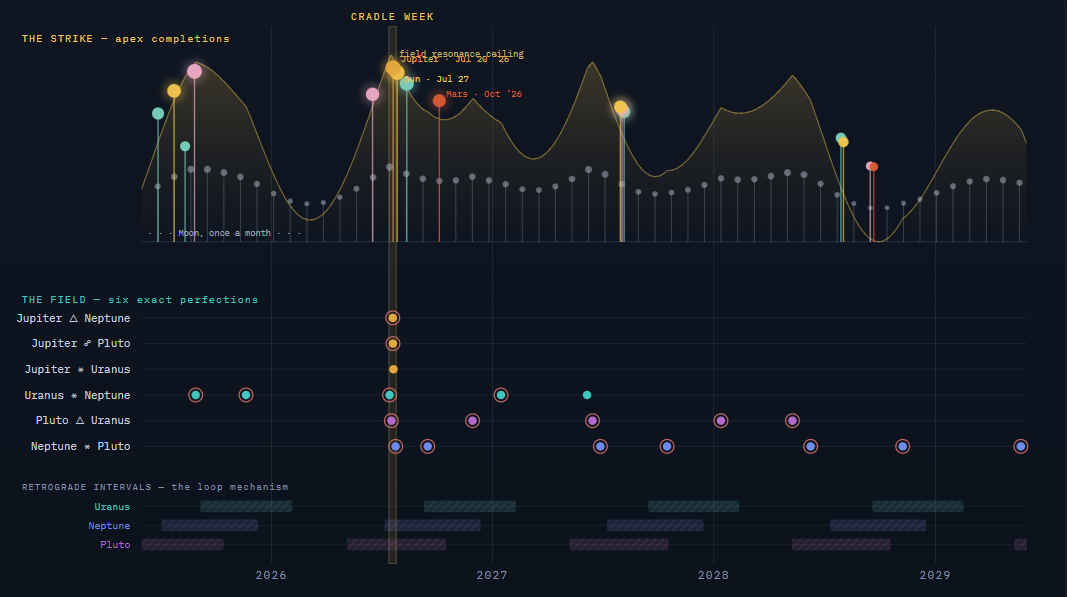
Read the upper staff as music, because that's genuinely what it is. The gold swell is the field envelope — the widest mutual orb of the three standing legs, which bottoms out at 0.11° the week of July 18, 2026 and opens up on either side. The notes rising off the baseline are the apex strikes, and their height is scaled to how exact each completion is. Here's the part I find beautiful, and I want to be clear it is not a design flourish: strike tightness tracks the envelope on its own. Strikes near the crest are exact and tall; strikes in 2028 are loose and short. The whole field crescendos into July 2026 and decays after — a four-year decrescendo that is sitting there in the ephemeris, not imposed on it. The Moon lays down its monthly comb along the floor; Sun, Mercury, and Venus stack into summer chords; Mars strikes alone in the autumn of 2026; Jupiter is the one towering note at the crest.
The lower staff is the skeleton underneath the song — the six exact perfections, ringed in rose wherever a body is retrograde, sitting over the hatched retrograde intervals that drive the repetition. One gold column marks the "cradle week" through both staves, so you can see the trigger, the apex pulse, and the retrograde mechanism line up in a single vertical stroke.
What it means
I'll keep the interpretation disciplined, because the geometry is the part I can prove and the meaning is the part I can only offer.
The correction changes the reading. A configuration where two of the four members are retrograde is not a clean "launch window — grab it now." Retrograde planets give their significations inward, in review, on the second and third pass rather than the first. With Neptune and Pluto — the transformation-and-vision half of the basket — moving backward, the standing field reads less like a public breakthrough and more like a long interior reworking, revisited each time the slow planets loop back over their degrees. Jupiter and Uranus, the two direct members, carry whatever is outwardly expressed; the rest is being metabolized.
And because the apex is struck by a different body at each cadence, the character of the trigger changes with the striker. The Sun lights the figure through identity and vitality each summer; the Moon touches it monthly through mood and the body of the collective; Mars fires it through friction and action in October 2026; Jupiter, once, through expansion and largesse. The same structural aspect, rung by six different hammers. Barbault's read of this era as a sustained, altruistic phase of technological growth was a claim about the field, not the flashbulb — which is exactly the level at which I think this configuration wants to be read.
Where this lands in any individual life is a question of houses and natal contacts, and that's a reading, not a blog post. But the frame I'd hand anyone is this: stop watching for July 20 to happen to you. Watch the four-year decrescendo, and notice which of the annual re-strikes lands on something of yours.
How this was computed
This is a technical breakdown, so here is the technical part.
Every position, orb, perfection instant, station, apex completion, and envelope value above was computed on Moira, my clean-room astronomical engine, using a JPL DE-series ephemeris. Perfection instants were found by root-finding the signed aspect error to sub-minute precision, not by reading a table. Stations were found by bracketing the direction flips and bisecting. The apex completions are local minima of the simultaneous three-leg orb; the field envelope is the running maximum mutual orb of the three standing legs.
Because a claim is only as good as its cross-check, I independently recomputed the key instants in skyfield against DE440s. The two engines agree to under 0.01 arcminute at every perfection, including ones more than two years out. As a third check, the July 2026 fast contacts match the published professional ephemerides to the minute. Nothing here rests on a single source.
The scripts that generate the perfection table, the station list, and the resonance-score data are reproducible against any DE441 kernel. If you want to run them against your own chart's degrees, or extend the window, the code is available — and that, ultimately, is the difference between a technical breakdown and a screenshot with a caption.